 - Copy.webp)
 - Copy.webp)
Sitting down to Nepali food for the first time can be slightly disorienting. The menu is full of words you have never seen, half of them look like they might be Indian, half like they might be Chinese, and there is no obvious place to start. Most people default to the safest-sounding thing and miss the point entirely.
This guide fixes that. Below are ten traditional Nepali dishes worth knowing, what each one actually tastes like, and the order in which a first-time guest should approach them. By the end you will be able to walk into any authentic Nepalese restaurant in Copenhagen and order like someone who has done this before.
The 10 dishes, in order of priority
- Daal Bhat — the national dish
- Chicken Momo — the gateway dish
- Jhol Momo — the one people come back for
- Buff Momo, 5. Sekuwa, 6. Choila — the bold end of the menu
- 7. Chow Mein, 8. Fried Rice, 9. Vegan Curry, 10. Nepali Tea
Book a table or call +45 70 60 56 57 to try them.
First, What Should You Expect From Nepali Cuisine?
Nepali food sits between the two great cooking traditions of Asia and belongs to neither. From India it inherited lentils, rice and the art of toasting whole spices. From Tibet and China it inherited dumplings, noodles and the wok. What Nepal added is restraint. Dishes use fewer ingredients, far less dairy, and let individual flavours stay recognisable rather than melting into a single sauce.
The signature note is timur, a Himalayan pepper that produces a light tingling sensation rather than burning heat. Alongside it you will find mustard oil for pungency, fresh coriander and spring onion for lift, and fermented greens for a savoury tang that has no real equivalent in Western cooking.
Crucially, Nepali food is not automatically hot. It is layered. Many dishes are naturally mild, and any good kitchen will adjust the heat to your preference. Just say so when you order.
The 10 Traditional Nepali Dishes You Must Try
1. Daal Bhat — Nepal’s National Dish
If you eat one thing, eat this. Daal bhat is fragrant steamed rice served with slow-cooked lentil soup, a seasonal vegetable curry, greens, pickle, and your choice of lamb, chicken, vegetarian or vegan accompaniments, all arranged on one generous platter.
What makes it special is not any single component but the way you eat it: mixing a little dal into the rice, adding a piece of vegetable, a touch of pickle, then a different combination on the next bite. No two mouthfuls are the same. This is what Nepali families actually eat, often twice a day, and every household has its own version. Ours follows the recipes our team grew up with.
2. Chicken Momo — The Gateway Dish
Hand-folded steamed dumplings filled with seasoned chicken, onion, ginger, garlic, coriander and house spices, served with a roasted tomato and sesame chutney. The filling stays moist during steaming, which is why the first bite releases a small burst of broth. It is the most ordered dish on our menu and the easiest possible entry point into the cuisine.
3. Jhol Momo — The One People Come Back For
The same dumplings, served submerged in a warm, spiced sesame-tomato broth. Jhol means soup or gravy in Nepali. It is richer, messier and more dramatic than the steamed version, and it is the dish our regulars order when introducing a friend to Nepali food for the first time. Available in chicken and vegan.
4. Buff Momo — The Purist’s Choice
Buffalo is the traditional momo filling in the Kathmandu Valley, and it delivers a deeper, richer flavour than chicken with a texture that stands up to the spice blend. If you want the version most Nepalis grew up eating, this is it.
5. Sekuwa — Smoke From the Himalayan Grill
Sekuwa is Nepal’s grilled meat tradition. Chicken or lamb is marinated in ginger, garlic, timur, cumin and chilli, then cooked over open heat until the edges char and the smoke works its way into the meat. Rustic, direct and deeply savoury, it is the food of roadside grills and mountain villages, and it needs nothing more than a cold drink beside it.
6. Choila — Bold, Smoky and Unforgettable
A Newari speciality from the Kathmandu Valley. Grilled meat is tossed with mustard oil, fresh ginger, garlic, chilli, toasted spices and coriander, producing something smoky, tangy and unapologetically vibrant. Choila does not whisper. It is the plate that starts conversations at the table and disappears first.
7. Nepali-Style Chow Mein
Proof of Nepal’s northern influence. Wok-fired noodles with vegetables and your choice of chicken, king prawn or vegan protein, cooked fast over high heat so the noodles pick up that distinctive smoky char. Nepali chow mein is drier and more spice-forward than the Chinese versions most people know, and it is one of the most popular street foods in Kathmandu.
8. Nepali Fried Rice
Fragrant rice stir-fried with vegetables, egg and aromatics, seasoned with Nepali spice rather than soy-heavy sauces. Lighter than it sounds and an excellent middle-ground dish for anyone at the table who wants something familiar. Available with chicken, king prawn or fully vegan.
9. Vegan Nepali Curry and the Vegan Platter
Because everyday Nepali eating has always been largely plant-based, the vegan options here are original rather than adapted. Seasonal vegetables, lentils and greens cooked with the same house spice blends, served either as a curry or as a complete vegan platter built on daal bhat principles. Guests looking for vegan Nepali food in Copenhagen consistently rate this among the best value plant-based meals in the city.
10. Nepali Tea (Chiya)
Finish the way Nepal finishes. Black tea simmered with milk, cardamom, ginger, cloves and cinnamon until sweet, fragrant and warming. In Nepal, chiya is not a beverage so much as a social ritual, offered to every guest who walks through a door. It is the perfect full stop after a spice-forward meal.
Ready to try all ten?
Turesensgade 6, central Copenhagen. Open from 16:00, Monday to Saturday.
Book a Table Call +45 70 60 56 57 Get DirectionsWhat Should a First-Time Visitor Actually Order?
Here is the order we recommend to guests who tell us they have never eaten Nepali food before.
- Start: Steamed chicken or vegan momo. It sets the reference point for everything else.
- Then: Chicken sekuwa or choila from the grill, so you experience the smoky, bold side of the cuisine.
- Main: The Daal Bhat Platter. This is the heart of Nepali home cooking and the dish that will explain the whole cuisine to you.
- If dining as two or more: Add jhol momo to share. It is the dish people remember.
- Finish: Nepali chiya.
For a group of four, ordering two momo varieties, one grill dish, one daal bhat platter and one wok dish to share gives you a complete picture of the cuisine in a single meal. That is how we would order it ourselves.
Is Nepali Food Healthy?
Broadly, yes, and daal bhat is the clearest example. Rice provides energy, lentils provide plant protein and fibre, vegetables and greens provide micronutrients, and pickles aid digestion. It is a naturally complete meal that has sustained an entire country of farmers and mountain porters for centuries.
Steamed momo are equally sensible: steamed rather than fried, portion-controlled, and built on lean protein and vegetables. Nepali cooking generally uses far less cream and butter than the Indian dishes people compare it to, which is why guests frequently mention feeling satisfied rather than heavy afterwards.
Nepali Food for Every Diet
One of the practical reasons Nepali cuisine works so well for groups is how easily it accommodates different eaters at the same table.
- Vegetarians and vegans get a dedicated platter plus vegan momo, curries, chow mein, fried rice and appetisers, all built on the same recipes rather than reduced versions of them.
- Meat lovers get the grill section, buff momo and the full daal bhat platter with lamb or chicken.
- Children are covered by a children’s menu with plain rice, mild dal, vegetables, simple chow mein and gently spiced chicken.
- Allergies are taken seriously. None of our dishes contain nuts. Tell your server before ordering and the kitchen will guide you.
- Spice sensitivity is not a problem. Heat is adjusted per dish on request.
Where to Experience Authentic Nepali Food in Copenhagen
You will find us at Turesensgade 6, st. tv, 1368 København K, in the heart of Indre By and an easy walk from Nørreport Station. Every dish is cooked to order, spices are roasted and ground in our own kitchen, and momo are folded by hand each day. If you have been searching for traditional Nepali food near you in Copenhagen, we are a few minutes from the city centre.
Visit Us
- Address: Turesensgade 6, st. tv, 1368 København K, Denmark
- Phone: +45 70 60 56 57
- Email: info@lamfuz.com
- Opening hours: Monday to Thursday 16:00–23:00, Friday and Saturday 16:00–23:30. Kitchen last orders 22:00, last arrival 21:30. Evening dining only, no lunch service.
- Google Business Profile: View Lamfuz on Google Maps
- Directions: Get walking, cycling or driving directions
- Reservations: Book online in under a minute or get in touch with the team
Takeaway is available across the full menu, and we cater office lunches, private parties, weddings and celebrations across Copenhagen. Want to go deeper? Read what a full evening at our Nepali restaurant looks like, browse the complete Nepali menu, or explore more guides on our blog.
Frequently Asked Questions
The questions first-time guests ask most often. Tap a question to open it.
What is Nepal’s national dish?
Daal bhat. It is a platter of steamed rice with slow-cooked lentil soup, seasonal vegetable curry, greens and pickle, served with a choice of lamb, chicken, vegetarian or vegan sides. Most Nepali households eat a version of it daily. See ours on the Lamfuz menu.
What should I eat first at a Nepali restaurant?
Start with hand-folded steamed momo, then move on to the Daal Bhat Platter. If you want the bolder side of the cuisine, add chicken sekuwa or choila from the grill.
What is Sekuwa?
Sekuwa is Nepali grilled meat, marinated in ginger, garlic, timur pepper, cumin and chilli, then cooked over open heat until smoky and charred at the edges. It is one of Nepal’s most loved street and celebration foods.
What is Choila?
Choila is a Newari dish from the Kathmandu Valley made by tossing grilled meat with mustard oil, ginger, garlic, chilli, toasted spices and fresh coriander. It is smoky, tangy and bold, and traditionally served at festivals and gatherings.
Is Daal Bhat healthy?
Yes. It combines rice for energy, lentils for plant protein and fibre, vegetables and greens for micronutrients, and pickles that aid digestion. It is one of the most naturally balanced complete meals in South Asian cooking.
Does Nepali food have vegan options?
Extensively. Everyday Nepali eating is largely plant-based, so vegan dishes are original rather than adapted. You will find a dedicated vegan platter plus vegan momo, curries, chow mein, fried rice and appetisers on the Lamfuz menu.
Where can I experience authentic Nepali food in Copenhagen?
At Lamfuz, Turesensgade 6, st. tv, 1368 København K, near Nørreport Station. Dishes are cooked to order using house-ground spice blends. Find us on Google Maps, get directions, or call +45 70 60 56 57.
Do you serve lunch, and do I need to book?
We are an evening dining restaurant. Doors open at 16:00 Monday to Saturday, the kitchen takes last orders at 22:00 and last arrival is 21:30. Booking is recommended at weekends — reserve your table online or call +45 70 60 56 57.
Ten dishes. One evening. The whole of Nepal.
Freshly cooked to order in the heart of Copenhagen.
Reserve Your Table Call Us Now Get DirectionsThere is a moment, somewhere around the third dumpling, when people stop talking. The basket arrives still steaming, the chutney is deep red and glossy, and the first bite releases a small burst of broth that was never mentioned on the menu. That silence is the most reliable review momo has ever received.
Momo is Nepal’s national obsession. It is eaten in Kathmandu office districts at lunchtime, sold from tin carts outside schools, served at weddings, and made at home on Saturdays by entire families sitting around a table folding together. No other dish carries that much daily affection.
This guide covers where momo came from, why Nepal fell in love with it, the different varieties you will encounter, and where to find genuinely handmade momo in Copenhagen. If you have been hunting for the best momo in Copenhagen, start here.
Momo at a glance
- What it is: a hand-folded Nepali dumpling with a juicy spiced filling
- Best first order: steamed chicken or vegan momo
- The one people remember: jhol momo, served in spiced sesame-tomato broth
- The secret: roasted tomato and toasted sesame chutney, made in-house
- Where: folded fresh daily at Lamfuz, Turesensgade 6 — book a table
What Is Momo?
Momo is a steamed dumpling made from a thin wheat-flour wrapper folded around a seasoned filling. That description is technically accurate and completely fails to capture the thing itself.
What separates momo from other dumplings is the filling. Nepali momo filling is not just minced meat or vegetables. It is a wet, aromatic mixture bound with finely chopped onion, garlic, ginger, coriander, spring onion and a house spice blend, worked until it holds together. When the dumpling steams, that moisture turns into a small pocket of broth inside the wrapper. That is why experienced momo eaters take a careful first bite rather than a confident one.
The second difference is the chutney. In Nepal, momo without achar is unfinished. The classic accompaniment is a tomato and sesame chutney, made by roasting tomatoes until they blister, toasting sesame seeds, and blending them with garlic, chilli and often a touch of timur pepper. It is nutty, tangy, gently spiced and slightly smoky, and it transforms the dumpling completely.
Is Momo Chinese or Nepali?
The honest answer: the ancestry is Himalayan and Tibetan, but what exists today is unmistakably Nepali.
Dumplings travelled along trade routes across the Himalayas for centuries, arriving in the Kathmandu Valley with Tibetan and Newari traders. Nepal did what it does with every borrowed idea. It kept the shape and rewrote the soul. The filling picked up Nepali spice logic, the chutney appeared, the jhol version was invented, and within a few generations momo stopped being a foreign dish and became the food Nepalis miss most when they live abroad.
So calling momo simply Chinese misses the point in the same way calling pizza simply Middle Eastern flatbread would. The technique travelled. The dish, as you eat it today, is Nepal’s.
Why Nepal Loves Momo So Much
Ask ten Nepalis why momo matters and you will get ten versions of the same answer: it is the food you eat with other people.
Momo is democratic. It costs very little at a street stall and appears on the menu of the most expensive restaurants in Kathmandu, and it is the same dish in both places. It is social, because folding momo at home is a group activity and eating them is naturally shared. It is fast, filling and comforting. And it is endlessly adaptable, which is why buff, chicken, vegetable, paneer, cheese and even chocolate versions all exist.
There is also nostalgia. For the Nepali community in Denmark, a good plate of momo is not just dinner. It is a direct line home. That is a heavy responsibility for a kitchen, and it is one of the reasons we fold ours by hand every single day rather than buying them frozen.
The Different Types of Momo You Should Know
Steamed Momo
The original and still the benchmark. Cooked in a stacked steamer until the wrapper turns translucent and slightly silky. Served plain with chutney on the side. If a kitchen can make excellent steamed momo, it can make everything else. There is nowhere to hide.
Jhol Momo
The showstopper. Steamed momo served submerged in a warm, spiced sesame-tomato broth, garnished with coriander. Jhol means “soup” or “gravy” in Nepali. It is somewhere between a dumpling plate and a bowl of soup, it is impossible to eat neatly, and it is the dish our regulars order when they want to impress a friend. If you only try one variation, make it this one.
Fried Momo (Kothey and Deep-Fried)
Kothey momo are pan-fried on one side so the base crisps while the top stays soft, giving you two textures in one bite. Fully deep-fried momo are crunchier and hold up beautifully with a cold drink. Both are popular evening food in Nepal.
C-Momo (Chilli Momo)
Fried momo tossed in a spicy, tangy sauce with onion and capsicum. Loud, messy and hugely popular with a younger crowd in Kathmandu.
Buff Momo
Buffalo meat is the traditional filling in the Kathmandu Valley and remains the purist’s choice. Richer and deeper in flavour than chicken, with a texture that stands up to the spice blend.
Chicken Momo
The most popular version internationally, and the one most first-time guests choose. Lighter than buff, still juicy, and an ideal starting point.
Vegetable and Vegan Momo
Cabbage, carrot, onion, spring onion, mushroom and herbs, seasoned with the same spice base as the meat versions. Made properly, vegan momo is not a compromise. Plenty of our meat-eating guests order them by choice.
Hand-folded momo, steamed to order, every evening.
Turesensgade 6, central Copenhagen. Doors open at 16:00.
Book a Table Call +45 70 60 56 57 Get DirectionsSteamed vs Fried vs Jhol: Which Should You Order?
A quick guide for your first visit:
- First time eating momo ever? Steamed chicken momo. It is the purest expression of the dish and lets you taste the filling and chutney properly.
- Want the experience people talk about? Jhol momo. The broth is the reason people come back.
- Eating with drinks? Fried momo. The crisp exterior pairs perfectly with a cold beer.
- Dining as a group? Order two or three types and share. This is exactly how momo is eaten in Nepal.
- Plant-based? Vegan momo, then jhol vegan momo if you want the full experience.
You can see the complete range, including sizes and fillings, on our momo and Nepali food menu.
Why Handmade Matters More Than People Realise
Frozen, machine-pressed dumplings are everywhere, and they are not the same product. The wrapper is thicker and doughier because it has to survive freezing. The filling is drier because moisture ruins frozen texture. And because a machine seals rather than folds, you lose the pleated crown that traps steam and keeps the dumpling juicy.
Hand-folding is slow work. Our team rolls and fills momo fresh each day, pleating each one closed so the filling stays sealed and the broth forms inside during steaming. It is the least efficient thing we do and the least negotiable.
You can taste the difference immediately: a thinner wrapper that gives rather than resists, a filling that is still moist, and that first small rush of broth. Guests looking for handmade dumplings in Copenhagen usually notice it before they can explain it.
The Chutney: Nepal’s Secret Weapon
Our signature sesame and tomato chutney is made in-house and it is the element guests ask about most often. Tomatoes are roasted until the skins blister and the sugars concentrate. Sesame seeds are toasted separately until they smell nutty. Garlic, ginger, dried chilli and timur pepper go in, and everything is ground into a thick, glossy sauce with real depth.
It is not a dipping sauce in the Western sense. It is a component of the dish. Skip it and you are eating a different, lesser meal. Many guests end up asking for extra, and we are never surprised.
Are Momo Healthy?
Steamed momo are one of the more sensible things you can order at a restaurant. They are steamed rather than fried, portion-controlled by nature, and built around lean protein and vegetables rather than heavy sauces or cream. The chutney is vegetable and seed based rather than dairy based.
Fried and c-momo are naturally richer, and jhol momo sits comfortably in the middle. If you are watching what you eat, steamed vegetable or chicken momo with chutney is a genuinely balanced meal.
Where to Eat Handmade Momo in Copenhagen
We are at Turesensgade 6, st. tv, 1368 København K, a short walk from Nørreport Station in the heart of the city. Momo is the most ordered dish on our menu, and it is folded fresh in our kitchen every day we are open.
Visit Us
- Address: Turesensgade 6, st. tv, 1368 København K, Denmark
- Phone: +45 70 60 56 57
- Email: info@lamfuz.com
- Opening hours: Monday to Thursday 16:00–23:00, Friday and Saturday 16:00–23:30. Last food orders 22:00, last arrival 21:30.
- Google Business Profile: See Lamfuz on Google Maps
- Directions: Get one-tap directions
- Reservations: Book your table online
Momo travels well, so the full menu is available for takeaway. Order by phone or drop in, and we will have it freshly steamed for collection. If momo has convinced you to explore further, read our guide to authentic Nepali dining in Copenhagen, or learn more about our kitchen and our story.
Frequently Asked Questions
Everything you wanted to know about Nepal’s favourite dumpling. Tap a question to open it.
What is momo?
Momo is a Nepali steamed dumpling made from a thin wheat wrapper folded around a seasoned filling of meat or vegetables mixed with onion, garlic, ginger, coriander and house spices. It is served with a roasted tomato and sesame chutney and is Nepal’s most popular comfort food.
Is momo Chinese or Nepali?
The dumpling technique arrived in Nepal via Himalayan and Tibetan trade routes, but the dish as it exists today — with its wet spiced filling, sesame-tomato chutney and jhol variation — is distinctly Nepali.
What is Jhol Momo?
Jhol momo are steamed dumplings served in a warm, spiced sesame and tomato broth. Jhol means soup or gravy in Nepali. It is one of the most loved variations and a guest favourite here. See it on the momo menu.
Are momo spicy?
The dumplings themselves are gently spiced rather than hot. Most of the heat comes from the chutney, which can be enjoyed in small amounts or skipped entirely. Tell your server your preference and the kitchen will adjust.
Can I get vegetarian or vegan momo?
Yes. We fold vegetarian and vegan momo by hand daily, filled with cabbage, carrot, onion, spring onion and herbs seasoned with the same spice base as the meat versions. Browse the vegan options on our menu.
Where can I eat handmade momo in Copenhagen?
At Lamfuz, Turesensgade 6, st. tv, 1368 København K, near Nørreport Station. Our momo are hand-folded fresh every day. Find us on Google Maps, get directions, or call +45 70 60 56 57.
What sauce is served with Nepali momo?
Traditional Nepali momo is served with achar, most commonly a roasted tomato and toasted sesame chutney blended with garlic, ginger, chilli and timur pepper. Ours is made in-house and is nutty, tangy and lightly smoky.
Can I order momo as takeaway?
Yes, the full menu is available for takeaway and momo travel particularly well. Call +45 70 60 56 57 or drop in, and we will have them freshly steamed for collection. Prefer to dine in? Book a table here.
Come for the momo. Stay for the experience.
Folded by hand, steamed to order, served with our signature chutney.
Reserve Your Table Call Us Now Get Directions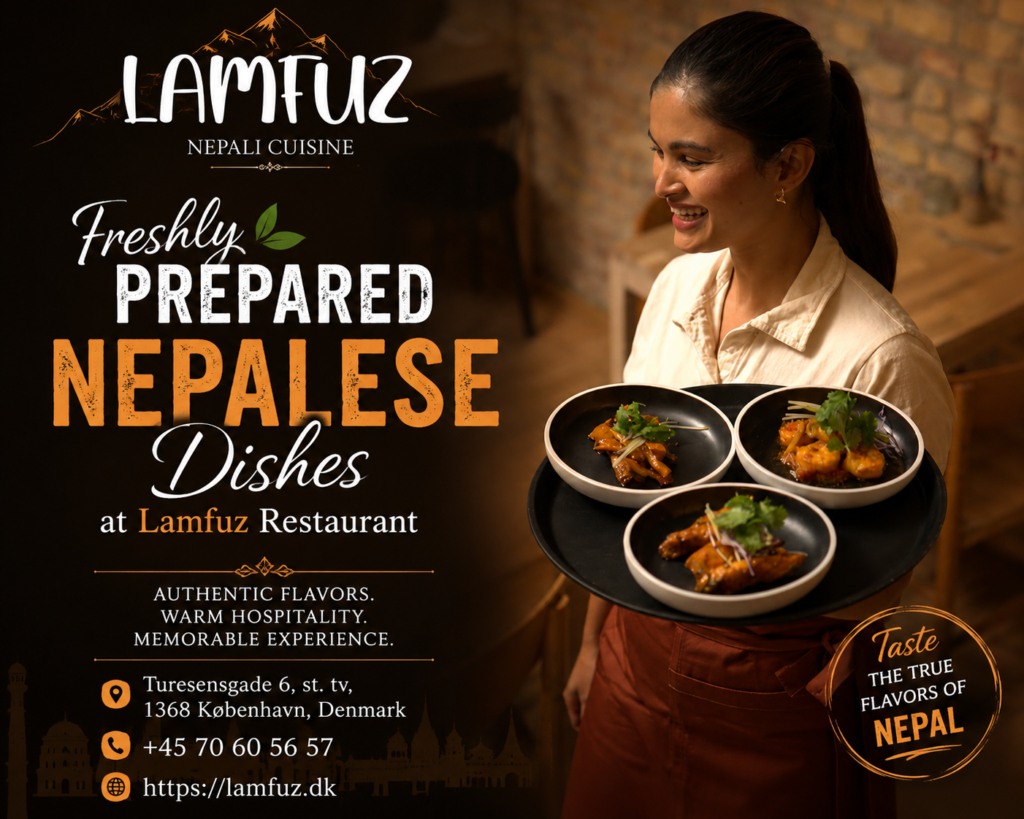
Somewhere between the steam rising off a basket of hand-folded momo and the smoky char of meat fresh from the grill, you stop comparing Nepali food to anything else. It simply becomes its own craving.
Copenhagen has never been short of dining options. Yet ask most locals where to find the food of the Himalayas, cooked the way it is cooked in Kathmandu homes, and you will often get a pause. That pause is exactly why Lamfuz exists. Tucked away on Turesensgade in the heart of the city, our kitchen serves one purpose: to bring the genuine flavours of Nepal to Danish tables, one freshly prepared dish at a time.
If you have been searching for an authentic Nepali restaurant in Copenhagen, this is your invitation to slow down, pull up a chair, and discover what generations of Himalayan home cooking taste like when they are treated with real care.
What Makes Nepali Cuisine So Special?
Nepal sits between two culinary giants, India and China, yet its food belongs entirely to itself. It borrows the warmth of slow-toasted spices from the south and the wok-fired energy of the north, then softens both into something balanced, comforting, and deeply satisfying. Nepalese cooking is not about overwhelming heat. It is about layers: cumin and coriander toasted until fragrant, timur pepper that tingles rather than burns, mustard greens, fresh ginger, and garlic building a base that makes every bite feel complete.
Every dish in our kitchen is prepared to order. Nothing sits under a heat lamp. Spice blends are roasted and ground in-house, produce is sourced from the local market, and the recipes come straight from family tradition. That combination of freshness and heritage is what people mean when they talk about authentic Nepalese food in Copenhagen, and it is the standard we refuse to compromise on.
Signature Dishes Worth Crossing the City For
Hand-Folded MoMo: Nepal’s Beloved Dumpling
If Nepal had to choose one dish to represent itself, it would be the momo. These delicate dumplings are folded by hand every single day in our kitchen, filled with seasoned meat or vegetables, then steamed until tender and served with our signature sesame and tomato chutney. For those who like a little drama on the plate, the Jhol MoMo arrives swimming in a warm, spiced broth that wakes up every taste bud.
Guests who search for the best momo in Copenhagen often tell us the same thing after their first basket: they finally understand why this humble dumpling inspires such devotion across Nepal, from street stalls to celebration tables.
Chicken Sekuwa: Smoke, Spice, and Simplicity
Sekuwa is Nepal’s answer to the grill. Tender pieces of chicken are marinated in Himalayan spices, then cooked over open heat until the edges char and the smoke works its way deep into the meat. It is rustic, bold, and impossible to eat slowly. Pair it with a cold drink and good company, and you have the essence of a Nepalese evening.
Chicken Choila: Bold and Unforgettable
Choila comes from the Newari community of the Kathmandu Valley, and it does not whisper. Grilled chicken is tossed with mustard oil, fresh ginger, garlic, chilli, and aromatic spices, creating a dish that is smoky, tangy, and vibrant all at once. It is the kind of plate that starts conversations and empties quickly.
Spicy King Prawns: A Coastal Twist on Himalayan Heat
Plump king prawns meet a fiery, aromatic sauce built on our house spice blends. The sweetness of the prawns against the warmth of the chilli is a pairing our regulars return for again and again. If you enjoy seafood with personality, start here.
The Daal Bhat Platter: Nepal on One Plate
Ask anyone from Nepal what they eat at home, and the answer is daal bhat. Fragrant rice, slow-simmered lentils, seasonal vegetables, pickles, and your choice of lamb, chicken, vegetarian, or vegan sides, all arranged on a single generous platter. It is wholesome, balanced, and endlessly comforting. Every Nepalese family has its own version, and ours carries the recipes we grew up with. For first-time visitors, this platter is the single best introduction to the cuisine.
An Evening Dining Experience in the Heart of the City
Our doors open at 16:00, and everything about the space is designed for the evening. Please note that we do not serve lunch; ours is a dinner destination, and we like it that way. The slower pace of the evening lets our chefs cook every order fresh, and it lets you settle in properly, whether you are here for a relaxed dinner for two, a long catch-up with friends, or your very first taste of the Himalayas.
The room itself is warm and unhurried: rustic interiors, natural wood, soft music, and the aroma of spices being toasted and ground drifting from the open kitchen. You can catch glimpses of the chefs at work, which is part of the charm. For quieter occasions, a second dining room seats up to ten guests, ideal for small celebrations, family dinners, or intimate gatherings.
What ties it all together is hospitality. Nepal is famous for treating guests like family, and that spirit is served here alongside every plate. Whether you arrive knowing exactly what to order or need a friendly walk through the menu, you will be looked after from the moment you step in.
There is also something to raise a glass with. Alongside the food, you will find a selection of beers, cocktails, and refreshing mocktails that pair beautifully with the spice-forward menu. A cold drink next to a plate of smoky sekuwa, with soft music in the background and the city winding down outside the window, is Danish hygge with a Himalayan accent. In warmer months, outdoor seating opens up too, so you can enjoy your meal under the open sky.
Something for Every Guest at the Table
Nepalese cuisine is naturally generous to every kind of eater. Meat lovers have the grill section and rich curries. Vegetarians and vegans have a dedicated platter plus a wide choice of momo, chow mein, fried rice, and appetisers built around vegetables and plant-based ingredients. Spice levels are flexible too. Many dishes are naturally mild, and the kitchen happily adjusts heat to suit your comfort, so tell your server exactly how bold you want to go.
Families are welcome as well. A children’s menu with simple, gentle dishes means the youngest guests at the table are just as well fed as everyone else. And if you have allergies, let the team know before ordering; none of the dishes contain nuts, and the kitchen takes dietary needs seriously.
Where to Find Us in Copenhagen
You will find us at Turesensgade 6, st. tv, 1368 København K, a short stroll from the lakes and an easy walk from Nørreport Station, which makes us a convenient stop whether you live in the city or are visiting for a few days. If you have ever typed “Nepali restaurant near me” while wandering central Copenhagen, chances are you were only a few minutes from our door.
Visit Us
- Address: Turesensgade 6, st. tv, 1368 København, Denmark
- Phone: +45 70 60 56 57
- Hours: Monday to Thursday 16:00 to 23:00, Friday and Saturday 16:00 to 23:30 (kitchen takes last orders at 22:00, last arrival 21:30)
- Directions: Get Google Maps directions
- Reservations: Book your table online or call ahead
Takeaway is available across the full menu, so if a cosy night at home sounds better, simply order by phone or stop by and we will have your food freshly prepared for collection. We also cater private parties, weddings, and celebrations across Copenhagen; send the team an email with your guest count and occasion, and a menu will be built around it.
Why Guests Keep Coming Back
Plenty of restaurants serve food. Fewer serve a feeling. What brings people back here, night after night, is the combination of things that cannot be rushed: dumplings folded by hand that morning, spices ground in-house hours before service, recipes carried across continents by family memory, and a welcome that makes strangers feel like regulars by the end of their first visit.
Reviews and word of mouth have quietly made this spot one of the city’s favourite hidden gems for Himalayan flavours. But no review reads quite like the food tastes. The smoke on the sekuwa, the tang of the choila, the comfort of the daal bhat platter; these are things you have to experience at the table.
So if you are still hunting for a genuine Nepali restaurant in Copenhagen, consider the search over. At Lamfuz, you come for the momo, stay for the experience, and leave already planning your next visit.
Experience the true taste of Nepal tonight. Fresh, flavourful, and made with passion.
Reserve Your Table Call Us Now Get DirectionsFrequently Asked Questions
Do you serve lunch?
No, we are an evening dining restaurant. Doors open at 16:00 Monday to Saturday, and the kitchen takes its last food orders at 22:00, with last arrival at 21:30. We recommend arriving with time to enjoy the full experience.
Do I need to book a table in advance?
Booking is recommended, especially on Friday and Saturday evenings. You can reserve online in under a minute or call +45 70 60 56 57. For groups larger than eight guests, please email the team so your visit can be arranged properly.
Is Nepalese food very spicy?
Not necessarily. Nepalese cuisine is about balanced, layered flavours rather than pure heat. Many dishes are naturally mild, and the kitchen is happy to adjust spice levels to your taste. Just let your server know when ordering.
What should a first-time visitor order?
Start with the hand-folded momo, the most ordered dish on the menu, then move to the Daal Bhat Platter for the heart of everyday Nepali cooking. If you enjoy bolder flavours, the Chicken Sekuwa, Chicken Choila, and Spicy King Prawns are guest favourites.
Do you have vegetarian and vegan options?
Absolutely. There is a dedicated vegan platter plus a wide selection of vegetarian and vegan momo, chow mein, fried rice, and appetisers. Every part of the menu has plant-based choices.
Is takeaway available?
Yes, the full menu is available for takeaway. Order by phone or drop by in person, and your food will be freshly cooked for collection.
Where exactly is the restaurant located?
At Turesensgade 6, st. tv, 1368 København, Denmark, in central Copenhagen within easy walking distance of Nørreport Station. You can find us on Google Maps for one-tap directions.